…this is an unedited version of an article I wrote for The Review.
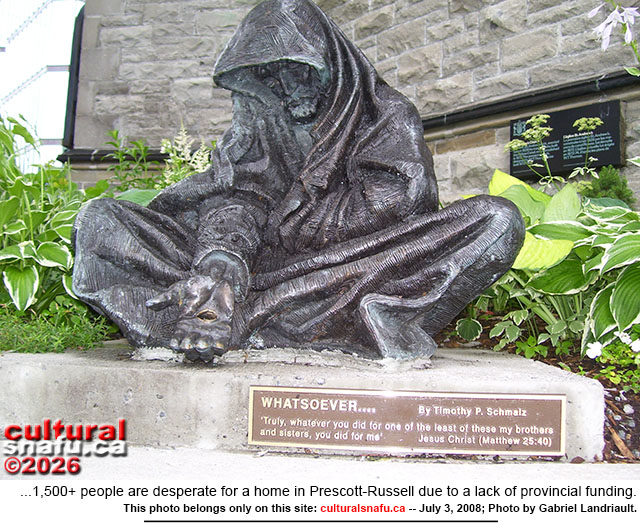
There are more than 1,500 people across the United Counties of Prescott-Russell (UCPR) searching for a place to live because the counties lack the critical provincial and federal funding to properly address the twin crises of homelessness and a lack of low-income housing.
“These people are couch surfing, staying with friends and family, they’re in residences temporarily, we have some on the streets, or sleeping in their cars or campers,” says Nadia Séguin, the housing stability coordinator for the UCPR. Someone is considered homeless in Ontario if they are couch surfing or staying in a room in a larger home because someone does not want to live outside, “this counts as homelessness,” she says.
Affordable, subsidized housing is simply not available in the UCPR, according to Séguin. “We have a waiting list for subsidized housing of five to ten years.”
“There are just no houses available,” says Jennifer Lambert, the ten-year housing plan coordinator for the UCPR. “In terms of vacancies for affordable housing, in the past few years there have been two semi-detached homes built in Hawkesbury, and the UCPR bought property in Clarence Creek last year so that means there are twelve to thirteen more affordable units available.”
According to the Canada Mortgage and Housing Corporation (CMHC), rents in Hawkesbury are approximately 19% lower than the Ontario average, however the average rent for a 1 bedroom apartment in Hawkesbury averages $1,175 per month, and for a 2 bedroom it’s $1,600 per month. Far above what people on Social Assistance or receiving support from the Ontario Disability Support Program (ODSP) can afford. The UCPR does offer some funding to subsidize the rent for lower-income residents, however the money does not last long.
“The cost of everything is going up,” says Séguin. “People on ODSP or Social Assistance can come to us at the Housing Services but the subsidy doesn’t last long because we have too many people that need it, and there’s just not enough money for everybody. We have more people who are working part-time who are in needs of housing, and there are no apartments available, so they don’t have the financial resources to rent one, some might end up living in a room, but even they are expensive.”
Local volunteer groups are popping up in Hawkesbury to fill the gap and help people who are considered low-income, or homeless, says Ron Kallio, of Hawkesbury’s 440 Centre, a registered charity which provides free weekly meals for families in need.
“We feed 60-65 people every week,” says Kallio, a former Bombardier Aerospace engineer who now is part of the volunteer executive of the 440 Centre. “But we’ve been up over a hundred. We feed a lot of low-income and needy people from the area. We’re seeing more homeless come in, they’re getting comfortable with us, they know who we are now.”
Before the 440 Centre opened, Kallio, and the 440 team, met with Hawkesbury’s Victim Services, the Social Services Department of the United Counties of Prescott and Russell, the Hawkesbury food bank and the Eastern Ontario Health Unit to determine what the best course of action would be for the parish. At every meeting, they were told the same thing — Hawkesbury needed a hot lunch program for low-income residents.
“We were inspired by [homeless advocate] Rheal Thiboudeau,” Kallio says. “He was known as ‘L’acadien Préféré’. Someone from our Church saw him behind Burger King on a cold day in January, so we brought him into the Church with the food and clothes he had collected from donors, and when he moved back to New Brunswick we saw the need and knew we had to continue. We spent six months of research into social services and food banks to find out what [the city] needed, and we felt it needed a hot lunch program.”.
Kallio and the 440 Centre were able to find $10,000 in a start-up donation from the Anglican Diocese of Ottawa’s Future Fund, as well as $1,500 from Hawkesbury’s Rotary Club, so they were able to rebuild the kitchen at Hawkesbury’s Trinity Anglican Church, where the meals are currently served.
Hawkesbury’s OPP detachment, along with social workers from the Hawkesbury General Hospital (HGH), is also playing a role in getting the city’s homeless people the help they need.
“We’re out here every day,” says OPP Constable Pascale Boudreau, a member of the Mobile Crisis Response Team (MCRT). “We patrol the area and check on everyone and make sure they’re fine. If they need services, we’re able to direct them to the right one.”
Created in 2021, MCRT is a partnership between the OPP in Hawkesbury, and the HGH, with the goal of providing early intervention and options for people in the midst of a mental health-related crisis. More than 60% of the homeless in the UCPR are in Hawkesbury, according to a recent study.
“Because of its size, and that all the services are offered here,” says Boudreau, “Hawkesbury gives the homeless better access to those services. There’s only so much we can do, the main point for us as the MCRT Team is to make sure if they need services like food, clothes, we can be the liaison between them and the local agencies.”
It’s a lack of funding, however, that remains the major issue facing those who are trying to help the low-income and homeless population in the UCPR, says Lambert.
“[We need] a lot of things to happen in the next ten years,” she says. “The ten-year plan we’ve developed is made to work on the full continuum of housing, so homelessness, transitional housing, supportive housing, affordable housing, right up to affordable home ownership. There are strategies and goals for every level. We can slowly work on everything at the same time, but there are some priorities such as there is no specific shelter or transitional housing in the area. We need to build more to satisfy the needs at every level.”
“All the actors need to be involved,” Lambert continued. “The UCPR has to create opportunities and partnerships, but we need funding from provincial, federal sources, as well as developers. We need all levels to figure out how to build more and renovate what we have. All of the recent construction was done solely by the UCPR. If we want more housing, not just affordable housing, there has to be more provincial and federal funding for programs.”
“It all comes back to the funding,” Séguin says.
All candidates for every position in local municipal elections this month must have homelessness and housing as a major priority, says Lambert.
“It’s part of the priorities [for Prescott-Russell] that we have funding for affordable housing,” she says. “There are definitely programs in each municipality that are unique, Hawkesbury does not have the same issues as Champlain Township. There are several programs that we need to move forward on to make things progress. That’s why we have a ten-year Action Plan for housing and homelessness, which was put together by every municipality, partners in the community, developers, and we need [everyone] to take care of working on this plan.”