
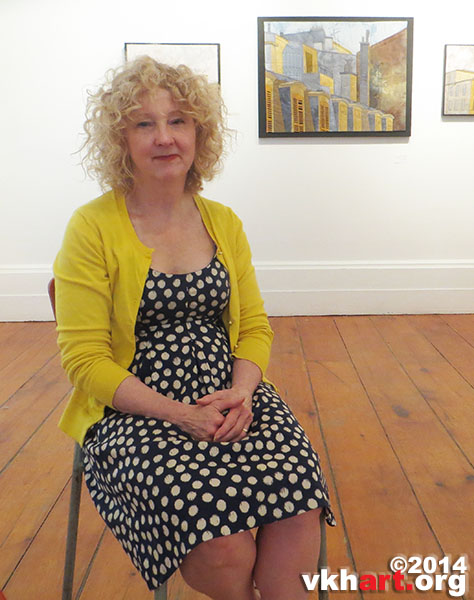
Heather Dubreuil’s solo show, ‘Cityscapes: Collages in Cloth & Stitch’, opened at the Arbor Gallery on Sunday, and she was kind enough to sit down for an interview.
Heather, who has been living and working in Hudson, Quebec, for almost three decades, works primarily with textiles. She takes her own photos of cityscapes and landscapes, and recreates the scenes in quilt form by cutting and dying fabric in her home studio, which is then stitched back together into a multi-layered, textured linear art.
Heather learned how to knit and crochet when she was very young, and spent most of her childhood making her own clothes. Now she uses the skylines of Montreal and New York City as her primary sources of inspiration.
According to Shanna Steals, who is curating Heather’s show, “we are invited to view what would appear as modern perspectives of repetitive architecture but through the lens of a long tradition of women’s work, stitching. With each line that is sewn and each square of fabric that is collaged together, Heather uses the technique of quilting to piece together parts of our mechanical landscape as well as our heritage.”
Heather and I also discussed the role of social media in getting her work to an audience, her love of Montreal, Quebec art politics, her mentors, and the process she went through to get her first shows.
…just a quick note: any audio problems are my fault — I mumble. I’d like to personally thank Heather for taking part in our continuing series of artist interviews.
Heather’s solo show at the Arbor Gallery continues until August 17.

Sometimes ‘WordPress’ will place ads on our posts… we don’t. Click or don’t click, it’s up to you.